
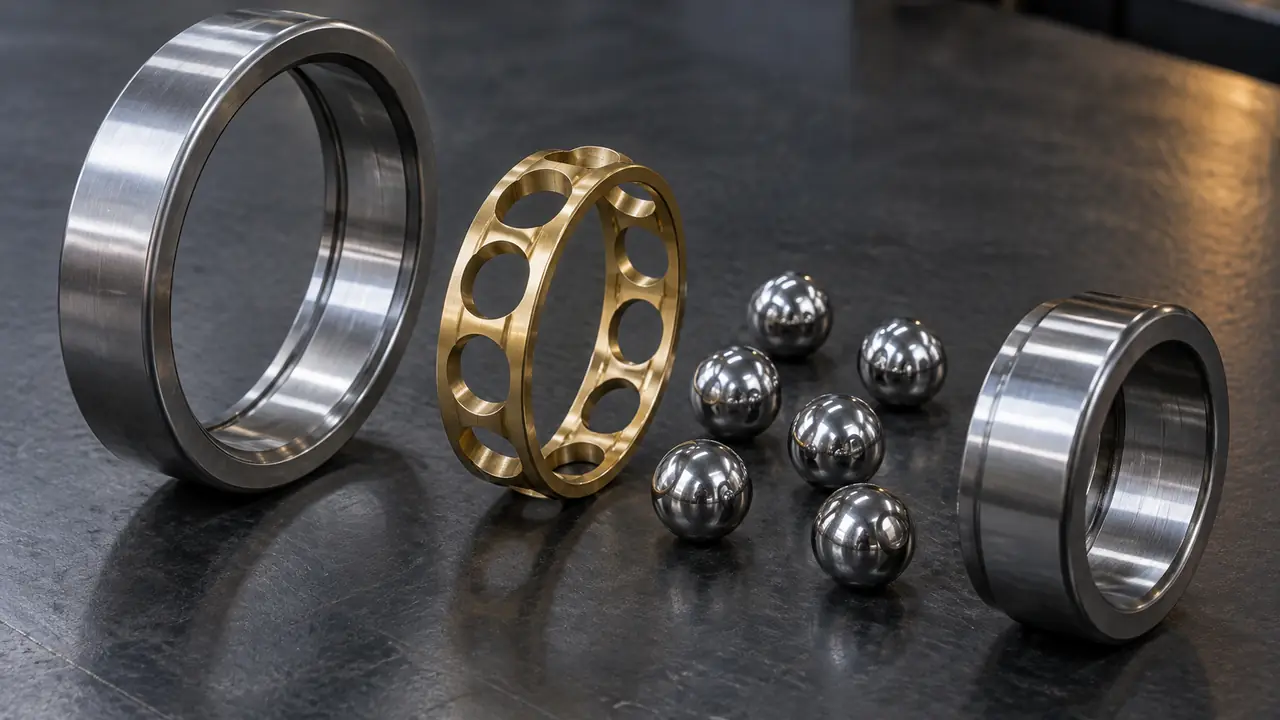
What a slewing bearing does
Most bearings carry a shaft. A slewing bearing carries a whole structure. It sits between a fixed base and a rotating platform, such as the tower and boom of a crane, the undercarriage and cab of an excavator, or the hub and tower of a wind turbine. It has a large diameter, a thick ring section and a hollow centre that leaves room for hydraulic, electrical and drive components. It rotates slowly, often with stops and starts, and sometimes only oscillates through an arc.
What sets it apart is the load pattern. A slewing bearing carries an axial load from the weight of the structure, a radial load from side forces, and a tilting moment from the overhanging boom or blade that tries to roll the platform over. A conventional radial bearing or thrust bearing is designed for one of these; a slewing bearing is designed to take all three at once through a single set of raceways.
Main construction types
| Type | Rolling elements | Load capability | Typical use |
|---|---|---|---|
| Single-row four-point contact ball | One row of balls, raceways touching each ball at four points | Medium combined and moment load | Light cranes, excavators, turntables |
| Double-row ball | Two rows of balls of different diameters | Higher axial and moment load | Mobile and tower cranes |
| Crossed roller | Rollers crossed in alternate rows | Stiff, precise, high moment | Rotary tables, robots, medical equipment |
| Three-row roller | Separate roller rows for axial, counter-axial and radial | Heaviest loads | Wind turbines, large cranes, tunnel boring machines |
The ball types are lighter and cheaper; the roller types are stiffer and carry more but cost more and need more precise mounting surfaces. The choice depends on the moment load, which a slewing bearing supplier calculates from the machine geometry and duty cycle.
Gear teeth and seals
Many slewing bearings carry a gear cut into one ring, so a pinion on a motor can rotate the platform. Options are an external gear on the outer ring, an internal gear on the inner ring, or a gearless version for use with a separate drive. The tooth module, hardening and backlash are agreed with the customer and the drive supplier. Heat-treated tooth surfaces last longer, and a lubrication point is usually provided for the gear as well as the raceway.
The ring includes mounting holes, normally on a regular bolt circle, and lubrication nipples. Seals on both sides keep grease in and dirt out, and they matter because slewing bearings work outdoors. Unlike a standard bearing, a slewing ring is not rated in the same way by designation alone, so every project begins with a drawing.
Mounting: the structure is part of the bearing
A slewing bearing is relatively thin compared with its diameter, so it takes the shape of the surfaces it is bolted to. If the supporting structure is not flat or is not stiff, the bearing distorts and the raceway wears unevenly. The mounting surface should be machined flat to the tolerance specified by the supplier, and the bolts must be of the right grade, tightened evenly in a cross pattern to the specified torque. Many failures that look like bearing failures are in fact mounting problems. The unhardened "soft spot" marked on a ring, where the heat treatment of the raceway ends, should sit at a position away from the main load, as the manual indicates.
- Check flatness of both mounting faces before assembly.
- Use the specified bolt grade and torque, and re-check after initial running.
- Grease the raceway before the first run and rotate it to spread the grease.
- Keep the pinion mesh within the backlash recommended for the gear.
Lubrication, wear and service life
Slewing bearings turn slowly and often oscillate through a small arc. In that kind of motion the lubricant film is thin, and the balls or rollers keep pressing on the same spots on the raceway. Regular grease supply is therefore essential, and many machines have an automatic lubricator or a schedule that calls for fresh grease after a fixed number of operating hours. Rotate the structure slightly while greasing so that the new grease reaches the whole raceway rather than one zone.
Signs of trouble are usually visible from outside: rust-coloured grease points to water entering through a damaged seal, metal flakes in the grease point to raceway wear, and increasing tilt or play in the platform shows the bearing clearance has grown. Tilt measurement is a standard check in crane inspection routines. Because slewing bearings are expensive and slow to replace, preventive inspection is cheaper than a failure, and buyers who supply replacements should keep a record of drawing number, batch and the date of installation.
Seals deserve special attention on outdoor equipment. A cracked seal lets water in, and rust spreads from the raceway edge outward. Replace damaged seals early, and avoid pointing a high-pressure washer directly at the seal lip during cleaning.
How to brief a supplier
Because every slewing bearing is configured for its machine, a useful enquiry comes with numbers. The partner plant needs the type, outer and inner diameters, height, bolt circle diameter and number of holes, gear type and module, the load case (axial, radial and moment), the rotation speed, and the working environment, including temperature range. Material is normally a medium-carbon alloy steel with induction-hardened raceways, though the exact grade is specified per drawing.
Slewing bearings are a specialty line, produced mainly by large-bearing plants in the northern and central clusters, and they are quoted by drawing rather than from a stock list. That also means MOQs differ from standard catalogue items: small quantities are possible for repair and replacement, while serial supply for an OEM is planned on drawings and confirmed in writing for each program. The MOQ and lead time page gives the reference bands for standard stock parts for comparison.
When a standard bearing is enough
Not every rotating platform needs a slewing ring. A small turntable carrying light load can use a pair of thrust ball bearings with a radial locating bearing, or a large-diameter thin-section ball bearing. Moderate moment loads can sometimes be handled by a pair of tapered roller bearings set apart. The slewing ring is the solution when diameter is large, the centre must be hollow and the moment load is significant. If you are unsure, describe the structure in the quote form and the desk will ask the partner plant for a written recommendation.