
What boundary dimensions are
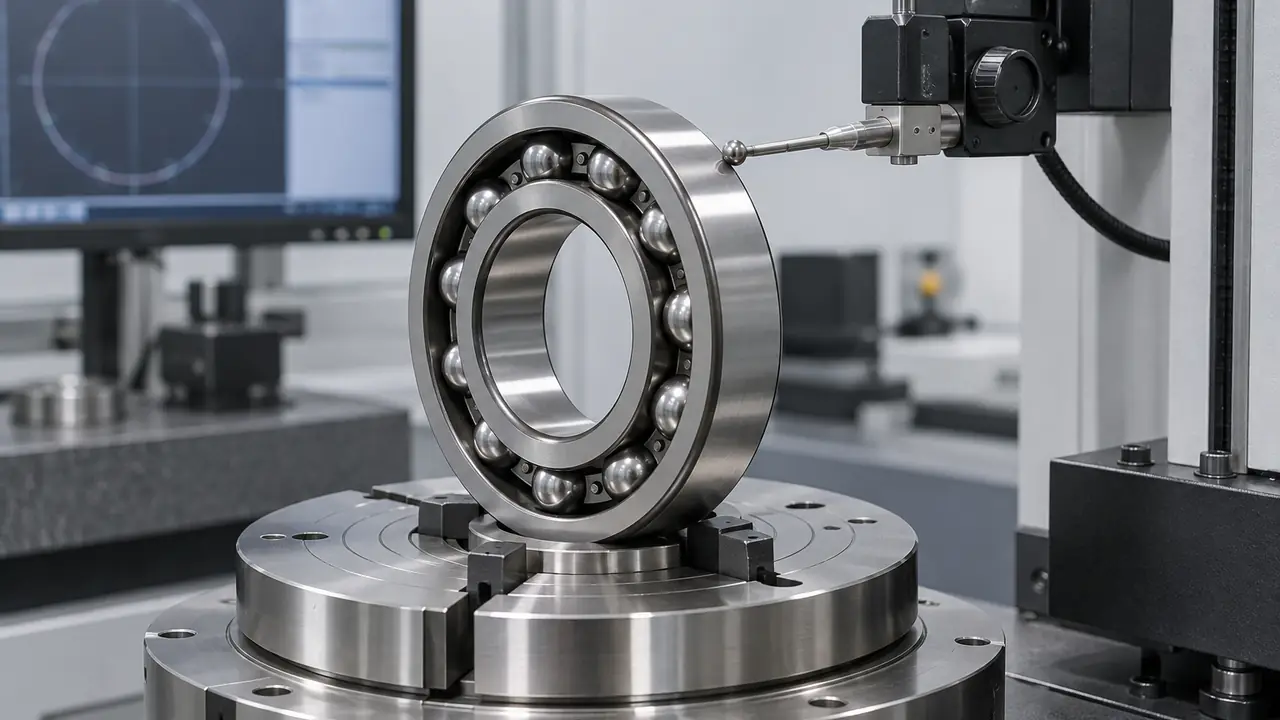
A radial bearing has three dimensions that decide whether it fits a machine: the bore diameter (d), the outside diameter (D) and the width (B). These are called the boundary dimensions because they define the space the bearing occupies. A small chamfer on each corner is also standardised, since it sets how close the shaft shoulder can sit. ISO 15 is the international standard that fixes these dimensions for metric radial bearings. Chinese GB/T standards follow the same system, so a bearing built to GB/T in Wenzhou or Wafangdian matches the same envelope as one built to ISO elsewhere.
The standard does not describe the inside of the bearing. It does not cover ball size, cage, clearance, material or load rating. It defines the outline only, and that is why it is so useful: it lets the machine designer, the housing maker and the bearing buyer work from a common set of numbers.
How the dimension series works
ISO 15 organises sizes by series. For a given bore, the standard offers several combinations of outside diameter and width, so you can choose a light, medium or heavy bearing for the same shaft. Two codes describe the series.
- Diameter series sets how large the outside diameter is relative to the bore. Series codes include 8, 9, 0, 1, 2, 3 and 4, from extra-light to heavy.
- Width series sets how wide the bearing is. Codes such as 0, 1 and 2 are common; width series 0 is often omitted from the designation.
Together, these appear as the middle digits of the designation. In 6203, the 6 marks a deep groove ball bearing, the 2 is the diameter series, the 0 is the width series that is usually left unwritten, and 03 is the bore code. Bore codes from 04 upward follow the rule of multiplying by five, giving 20 mm for 04, 25 mm for 05 and so on; the codes 00 to 03 map to 10, 12, 15 and 17 mm. The full logic is in the designation guide and bore code calculation.
| Designation | Bore d (mm) | Outside D (mm) | Width B (mm) | Series |
|---|---|---|---|---|
| 6003 | 17 | 35 | 10 | Extra light (10) |
| 6203 | 17 | 40 | 12 | Light (02) |
| 6303 | 17 | 47 | 14 | Medium (03) |
These are nominal ISO values; confirm against the drawing and supplier datasheet. The same 17 mm shaft can carry any of the three, with the heavier series offering larger rolling elements and higher load capacity in a bigger envelope.
Why interchange works, and what it covers
Because ISO 15 fixes the envelope, a bearing marked 6203 from any compliant plant should drop into a housing designed for a 6203. That is dimensional interchange. It is what lets distributors stock one designation from several sources, and what lets an OEM approve a second supplier without redesigning the machine.
The tolerance of each dimension is governed by a separate standard, ISO 492 for the precision class. Two bearings of the same designation in the same class will have the same nominal envelope and the same permitted deviation, so they fit the same seat in the same way. The bearing's inner details and class are other matters, as the next section explains.
Where interchange stops
Dimensional interchange is not performance interchange. Two bearings with the same designation can differ in several ways that matter in service.
| Item | Why it can differ | How to control it |
|---|---|---|
| Internal clearance | Suffix or default group differs | State C2, CN, C3 explicitly |
| Precision class | P0 by default, higher on request | State P6, P5 or P4 |
| Noise and vibration | Steel, grinding, balls, cage | Agree a vibration grade and a reference sample |
| Load rating and life | Internal geometry and steel quality | Request datasheet C and C0 values |
| Seal and grease | Different material and fill | State seal type, grease and fill |
| Cage | Steel, brass or nylon | State the cage on the order |
For this reason the desk does not describe any item as interchangeable with a specific brand's part, and does not promise it. We confirm the envelope and the options in writing, and the buyer checks function with samples.
Chamfers and shoulders: the small dimension that causes trouble
The corner chamfer is easy to overlook. ISO 15 sets a minimum chamfer for each size, usually given as r(min). The shaft or housing shoulder must be designed so that its fillet radius is smaller than this minimum, otherwise the ring cannot seat squarely against the shoulder and the bearing sits tilted. A tilted ring brings misalignment, uneven load and noise, and the problem is blamed on the bearing. The shoulder height also matters: it must be high enough to support the ring face, but low enough to leave room for a puller to grip the ring when the bearing is removed.
When you check incoming goods, measure the bore, outside diameter and width on a sample with calibrated gauges, and look at the chamfers by eye. Dimensions outside the permitted deviation for the stated class are a reason to reject the lot. This inspection step is part of the pre-shipment plan described on the quality control page.
Exceptions to the metric ISO 15 system
Not every bearing follows ISO 15. Inch-series tapered roller bearings, for example, use their own dimensional system, covered in inch vs metric bearings. Metric tapered roller bearings follow a separate standard, ISO 355. Some miniature, thin-section, needle and housed-unit products have dimension systems of their own. Always read the standard named on the datasheet instead of assuming ISO 15.
Using this when you source
For buyers, ISO 15 is a practical tool. It lets you consolidate stock around a small set of designations and ask several partner plants to quote against the same envelope. Compare quotes only when all the other options are equal, and send a clear specification: designation, class, clearance, seal, cage, grease and marking. The quote form collects the fields the desk needs to shortlist partner plants and the size chart gives nominal reference sizes for common series.